
FutureMetrics, a consultancy for project development and policy research in the biomass thermal energy sector, uses Palisade’s @RISK to accurately estimate wood costs, as one of the key input drivers of ROI for a biomass energy project or pellet project is the price of wood.
About FutureMetrics
Based in Bethel, Maine, FutureMetrics is recognized as one of the leading domestic experts in the economics of the production and use of renewable bioenergy. FutureMetrics is also recognized for its expertise in quantifying the financial feasibility of renewable energy projects and quantifying the economic impacts, such as jobs, growth and tax revenues of those projects.
Wood Pellet Popularity and Potential ROI
Recently, FutureMetrics and its partner Innovative Natural Resource Solutions (INRS) formed a new company, FutureEnergy Partners, to focus on the economics and risk of wood pellet production. In the next 10 years, the popularity in burning wood pellets as a heating source is expected to rise. But the significant expected growth in wood pellet demand is for the European electricity generation markets where carbon emission policies penalize coal combustion but not carbon neutral wood pellet fuel. Today, the global consumption of wood pellets is approximately 15 million tons per year. It is expected to exceed 45 million tons by 2020. The largest market for wood pellets exists in Europe, where regulations encourage the use of carbon neutral fuels, like biomass. With such a dramatic jump in global wood pellet consumption predicted in the future, FutureMetrics and INRS, via their partnership in FutureEnergy Partners developed a wood price hedging product that uses @RISK to measure its effectiveness. The model was based on a pellet manufacturing facility, which uses a biomass-fueled combined heat and power plant to power the manufacturing process. To power the facility and produce 300,000 tons of pellets annually, 750,000 tons of wood per year was required.
“I have been using @RISK since the early 1990’s, so I have a perspective on the commitment to the users that the Palisade team has,” said Dr. William Strauss, president and founder of FutureMetrics. “Every new version has new and very useful features that often are based on feedback from users. Palisade’s @RISK software has the richest feature set and has the most relevant tools for analyzing models that contain uncertainty.”
@RISK Offers Insight to Appropriate Price-Hedging
For wood-to-energy or wood pellet manufacturing projects, wood costs are the most important driver of changes in the bottom line. As prices are driven by a variety of factors, FutureMetrics and INRS researched wood price movements and created an econometric model that explained those movements. The parameters that drove the model were all commonly traded futures products, which allowed the companies to develop a strategy to hedge wood price fluctuations. Given the inherent variability in the price hedging model’s inputs, @RISK was utilized to create a comprehensive cash flow model for a wood pellet export project. In this analysis, the inputs came from two sources:
The explanatory variables of the wood price equation. The historical time series of wood costs were utilized to determine the proper probability distribution for each series, using @RISK’s distribution fitting feature. The actual wood cost time series was also considered, and a probability distribution was also estimated for the price of wood using @RISK. A beta general distribution was used to model the price of wood. That series then drives the cash flow model going out 10 years. The hedged outcome is then compared to the un-hedged outcome.
The project’s success was measured by net present value and return on investment. @RISK enabled the team to see the range of possible values for these metrics in the form of probability distributions, so the actual likelihood of a project making money or losing money could be easily quantified. The @RISK tornado charts assisted FutureMetrics and INRS to quantify the sensitivity of the project to changes in input costs.
President and Founder, FutureMetrics
Findings Using @RISK
Utilizing @RISK, FutureMetrics and INRS found that a pellet manufacturing plant generating 300,000 tons of pellets per year could expect a median ROI on the all-in capital costs of 25.14 percent over the 20 year life of the project. The companies were also interested in learning the probability that the project would lose money during that same time and in turn, how much could the plant expect to lose?
The research showed that there was a nine percent chance that the plant would have a negative NPV over a the life of the project period.
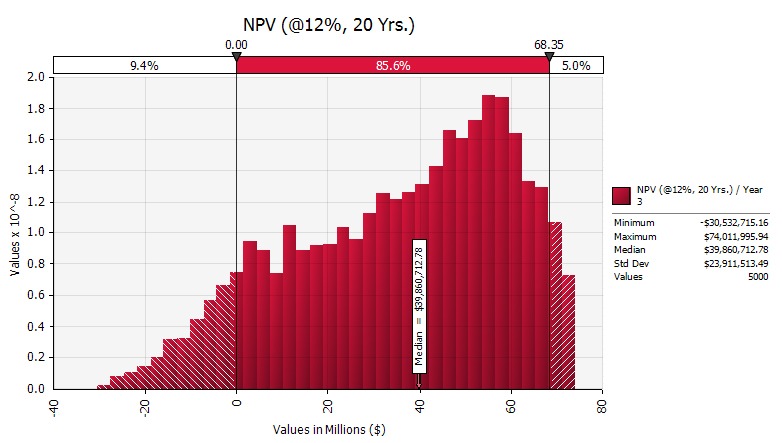
Figure 1: Without hedging, there was a nine percent probability of loss over a three-year period.
Looking at the sensitivity of the model to wood prices in @RISK, it became apparent that the price of the wood going into the pellet mill was critical. @RISK’s tornado chart on the model showed that for each $8.80 (which equals one standard deviation in the price of the wood) increase in wood prices, the NPV was lowered by $22.96 million. Since the expected NPV was only $35.7 million to begin with, the project was exposed to significant price risk.
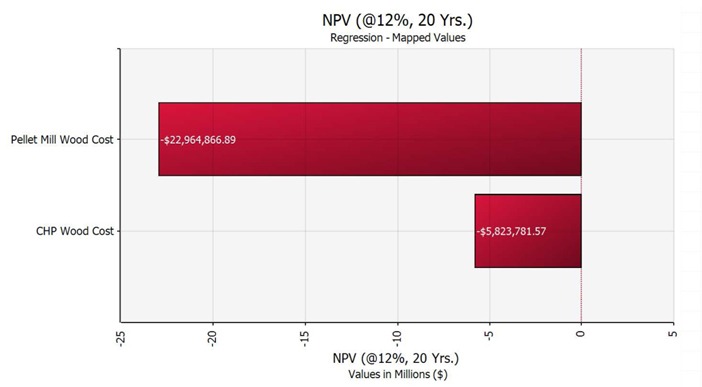
Figure 2: @RISK’s tornado graph shows that the price of wood going into the pellet mill had by far the greatest impact on NPV.
This risk can be mitigated by hedging their input wood prices. FutureMetrics and INRS then considered the case of the wood aggregator who buys wood from various sources and resells it to pellet manufacturers at a fixed price. In order for the aggregator to reduce its risks if it is going to offer a stable price to the pellet manufacturers, it too must find a way to hedge against market price fluctuations. Using an econometric model, a simulated set of wood prices, and @RISK, FutureMetrics and INRS determined that the aggregator had a huge 89.5% change of losing money without a hedge, with a mean expected loss of $143.9 million. With a price hedging strategy in place, the mean loss was drastically reduced to $18,000.
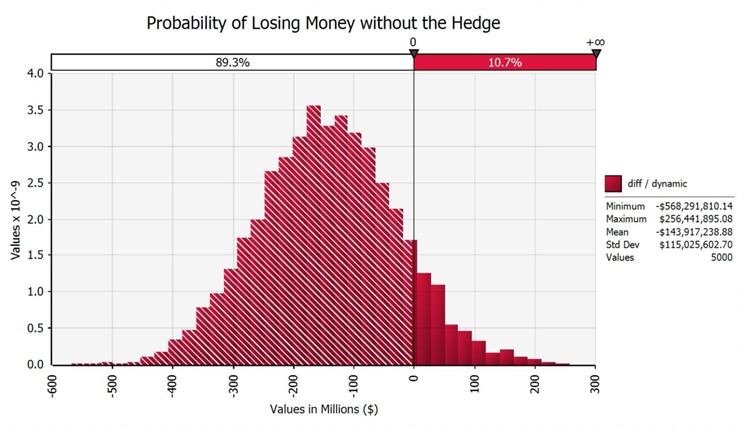
Figure 3: The probability of the aggregator losing money without a hedging strategy to insulate against market price fluctuations is 89%, with a mean loss of $143.9 million.
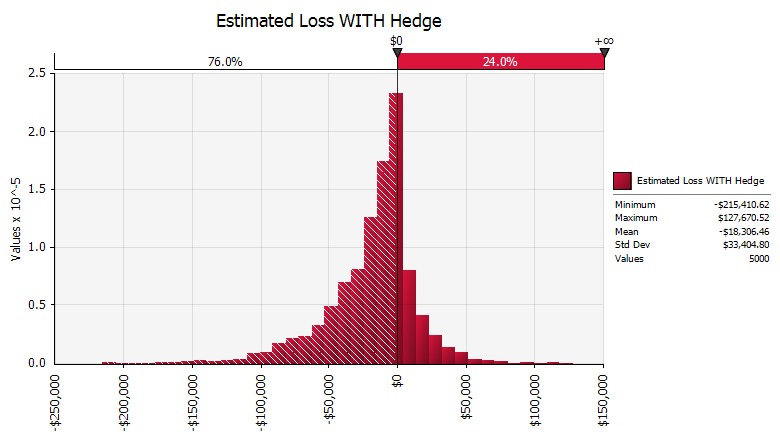
Figure 4: The wood aggregator’s potential loss with a hedging strategy are greatly reduced.
The ease by which complex Excel models can be altered to accept uncertain inputs, and the ease with which the simulations can be used to determine the outputs’ sensitivity to input variation, make @RISK a valuable tool for pricing and investment strategy. “@RISK is powerful, yet easy to learn, and has the ability to show complex solutions with intuitive visual outputs,” said Dr. Strauss. “Just like Excel, which is easy to learn but has a never-ending depth of features, @RISK allows new users to build models and run simulations very quickly from the Excel framework. But as the user learns to use @RISK, the software has the maturity, breadth and depth to support increasingly sophisticated models and techniques. However, no matter the complexity of the model, the product can show solutions in ways that communicate valuable information to decision makers who may or may not share the technical skills of the model designer.”
Using an econometric model, a simulated set of wood prices, and @RISK, FutureMetrics and INRS determined that the aggregator had a huge 89.5% change of losing money without a hedge, with a mean expected loss of $143.9 million. With a price hedging strategy in place, the mean loss was drastically reduced to $18,000.