
| 
Automating Cost Risk Analysis with @RISK
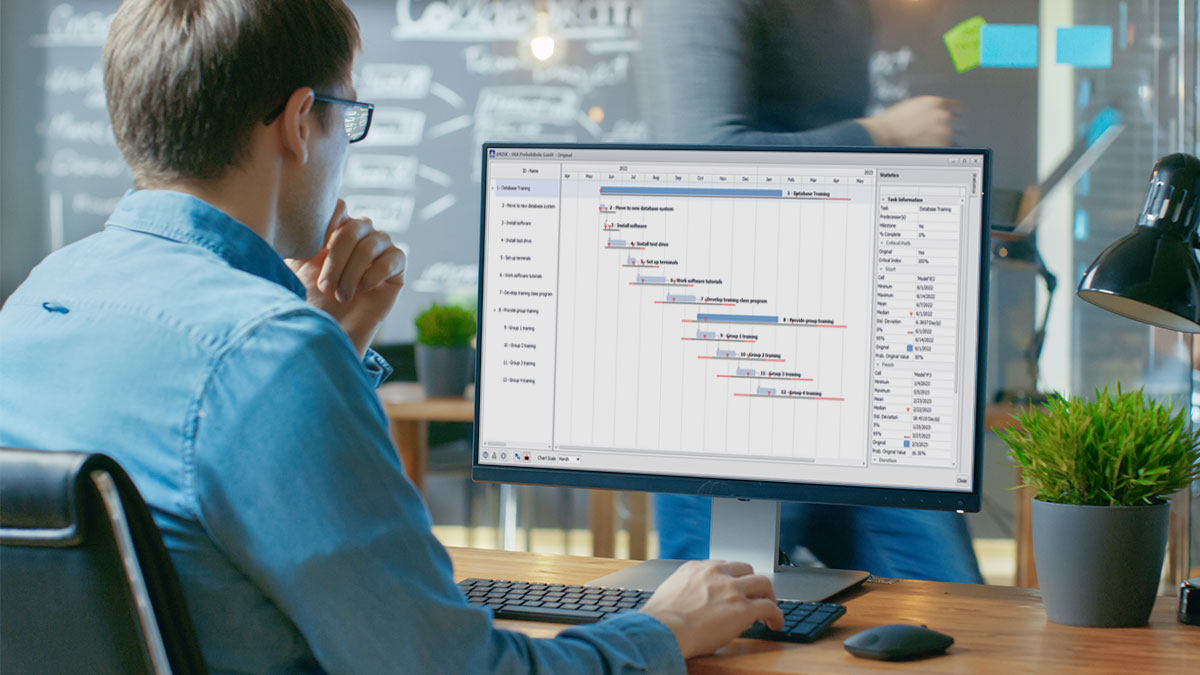
@RISK ships with a full-featured development environment that allows you to create custom applications in Excel with VBA that use @RISK functions, graphs, and features. One common application of @RISK using this Excel Developer Kit (XDK) is for cost estimation in projects ranging from construction to aerospace.


@RISK can be used to model cost ranges as well as risk registers, all using probability distribution functions in Excel. In addition, correlation between related variables can be captured by adding a correlation matrix to your cost model. After simulating different possible costs for a project, @RISK can be used to assess the contingencies required. In addition, @RISK can identify the key drivers needed for a mitigation analysis, and can run multiple simulations to compare the effectiveness of different mitigation strategies.
Palisade offers custom development services that utilize @RISK and DecisionTools technology for applications in cost estimation, asset allocation, retirement planning, and more. A recent webcast from Palisade Custom Development illustrates an automated cost estimation @RISK application.
» View the recorded webcast on cost estimation with @RISK
» Request more information or a demo of Palisade custom development examples
» Palisade Custom Development

Training, Case Studies, and More: October 21-22, New York City
Palisade is pleased to host its annual Risk Conference, to be held at the Hyatt Regency Jersey City, October 21-22, 2009. The multi-track schedule is now available and includes software training on @RISK 5.5 and the DecisionTools Suite 5.5. Industry case studies will be presented by Unilever, Momenta Pharmaceuticals, Indiana University, Columbia University, and many others on a wide range of current topics relating to risk analysis.
» View the schedule
» Register now and save $200
» Book your room at the Hyatt for only $239.
There are limited rooms at this rate. Call +1 201 469 1234 and
mention the Palisade conference.

This autumn, to celebrate the recent launch of @RISK 5.5 and the DecisionTools Suite 5.5, Palisade will be hosting a series of no-cost, two-hour seminars in cities around Europe. Including live demonstrations of the features and benefits of the new releases, the events will also show a variety of different industry applications. Sign up and gain valuable insight into why more than 90% of the Fortune 100 companies use Palisade solutions to make better decisions.
» See schedule and register
Upcoming Webcasts
"StatTools and Six Sigma”
Presented by Ed Biernat, President, Consulting with Impact
September 3, 2009, 11:00am EST
Consulting With Impact recently utilized StatTools in a two-week training session for Six Sigma Green Belt candidates as part of their certification. The very positive response from the candidates highlights the fact that StatTools works well with the Green Belt curriculum. This session will cover the attributes in StatTools that apply to Six Sigma with examples from a recent training session for Green Belts, including future enhancements to StatTools.
» Register now (There is no charge for this webcast.)
"Probabilistic Project Estimation Using Monte Carlo Simulation”
Presented by Jeff Slutsky, Global Director of DFSS, Bausch & Lomb, Inc.
September 17, 2009, 2:00pm EST
Variability exists everywhere, yet projects are commonly planned as though variability does not exist. Probabilistic project estimation uses more realistic estimates of variation. Monte Carlo simulation is applied to “execute” the project thousands of times, creating prediction confidence intervals that allow us to answer many common “what if” questions. Typical, PERT and probabilistic approaches to project estimation are discussed in this focused session, demonstrating the pros and cons of each. An example is then provided to demonstrate the use of probabilistic project estimation during the Concept stage of the Design for Six Sigma Concept - Design - Optimize – Verify ( CDOV ) product development process.
» Register now (There is no charge for this webcast.)
"Taking the Uncertainty Out of Energy Costs”
Presented by Mark Rudd, Rudd Asset Management
September 24, 2009, 11:00am EST
Hospitals use a lot of energy. Energy costs are a significant part of the costs for healthcare. How can that be brought under control, both in the short term and the long term? Rudd Asset Management, an energy consulting company, studied the current energy uses of a hospital to estimate the cost and financial results of a Combined Heat and Power system installation, and estimate the benefits using the customer assumptions. The study developed a Net Present Value analysis and modeled it using @RISK to develop projected outcomes, cost drivers, and project risks. The final result was provided to the hospital to give them options for controlling their energy costs both in the short term and for the future.
» Register now (There is no charge for this webcast.)
Palisade Blog Headlines
Palisade’s Custom Development Services
Wednesday, August 12, 2009
Dr. Javier Ordóñez, Director of Custom Development, will outline examples of custom Excel VBA programming in upcoming blog posts. Palisade Corporation now offers custom development services. Our consulting team can help you to automate your risk and decision analysis models so they can be easily used by everyone in your company, or even outside of it.
» Read more
Accelerating Product Design with Simulation
and
Stochastic Optimization
Tuesday, August 4, 2009
Andy Sleeper, President of Successful Statistics LLC, will present a case study at the 2009 Palisade Conference: Risk Analysis, Applications, & Training. The conference is set to take place on 21 - 22 October at the Hyatt Regency in Jersey City, 10 minutes by PATH from Manhattan's Financial District.
» Read more
Subscribe to the Palisade blogs.

Executive Pay for Performance using @RISK
Traditional executive incentive plans often encourage mediocrity and in many cases lead to the destruction of shareholder value. A key issue with executive compensation is the measure of performance and the terms of their compensation plan.
IDG Capital’s Value Based Management system incorporates Monte Carlo simulation using @RISK to create compensation packages which align management and shareholder interests. The system simulates ownership, and enables the calibration of a pay-for-performance plan that maximizes long-term shareholder value.
» View the recorded webcast

Insurance Claims with RiskCompound Cell Referencing
Modeling Uncertain Number of Events,
Each with Uncertain Parameters
The RiskCompound function allows for the sampling of frequency-severity distributions. This is often required in insurance modelling, as well as in some operations management situations. For example, to determine the total insurance claims payout, one must account for the uncertainty in both the total number of claims (frequency) and the dollar amount of each claim made (severity).
A powerful feature of the function is that the argument that corresponds to the severity may be a reference to a cell containing a formula (rather than just a single distribution function).
For example, one could use the function in the form RiskCompound(RiskPoisson(5), A10). The Poisson distribution would describe the frequency (occurrence) of events (e.g. an individual sample may determine that three events occur), and cell A10 would contain a formula that is separately evaluated for each of these three events (before returning the sum of these three as the sampled value of RiskCompound).
A simple example could be A10 = RiskLognorm(10000,1000)/(1.1^RiskWeibull(2,1)), with the Weibull distribution representing the time to settlement of an insurance claim, which is used to discount the basic claim value sampled from the Lognormal distribution of severity. For example, once a claim is filed for a nominal amount, the actual payment may be delayed due to court actions or disputes, which may reduce the cost of the claim to the insurer.
Download the example: RiskCompoundCellReferencing.xls
Climate Research
Engineer the Climate?
Technique: Decision Analysis » see DecisionTools Suite
Source: New York Times Blogs, August 10, 2009
Inviting reader comment, a New York Times science writer cites ongoing decision analysis models of the costs and benefits of re-engineering global climate.
Mass Transit
Passenger Flow for D.C.'s Metro stations
Technique: Decision Trees » see PrecisionTree
Source: Greater Greater Washington, August 10, 2009
A Washington, D.C. journalist uses recent survey data to create decision trees that map Metro passengers’ route preferences.
Speech Recognition
Researchers Shed Light on Brain's Speech Function
Technique: Neural Networks » see NeuralTools
Source: Innovations Report (Germany), August 10, 2009
Israeli scientists are using neural network technology to model how the process of speech decoding takes place at the cellular level.
|