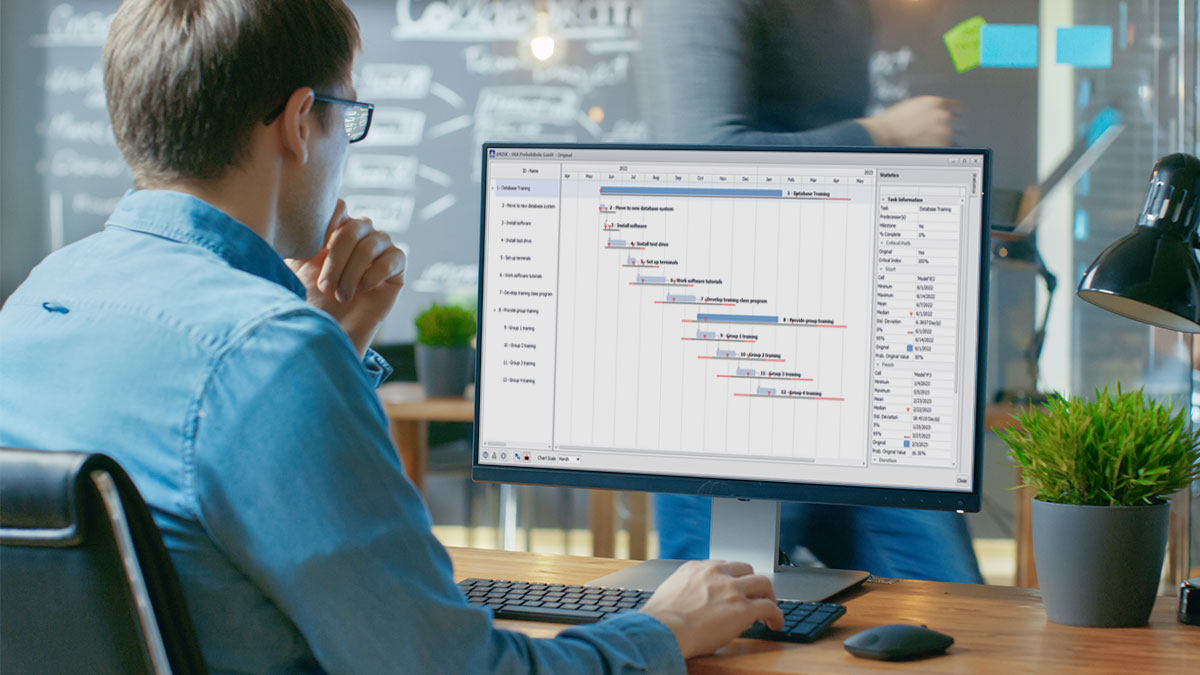

:: Live Web Training
Project Risk Assessment Using @RISK for Project
April 27-28
Dear Amy,
Is there any way to save a problem in Evolver or RISKOptimizer so that I can change constraints or data and optimize the problem without re-entering all the model information?
- R. M.


Dear R.M.,
Yes, there is. When you stop each optimization you have the choice to create an Optimization Summary worksheet.
Case Study:
In the Wake of Katrina, @RISK Helps
Predict Family Assistance Needs
The damage, destruction and dislocation of Hurricane Katrina are on a scale never before experienced in the United States. In the wake of the storm, the State of Louisiana set up a family assistance call center to address the needs of those affected. The center provides relief information, takes missing person data, and reconnects families. The center is using @RISK to predict call volumes and staffing requirements.
:: Call Center for Reporting and Assistance
When Hurricane Katrina made landfall, Henry Yennie was serving in the disaster response command center in Baton Rouge, Louisiana. As a program manager in the state’s Office of Mental Health, Yennie served on a team to deal with the aftermath of the storm. Upon the request of the National Disaster Medical System’s Disaster Mortuary Operational Response Team (NDMS/DMORT), the Office of Mental Health was asked to set up a family assistance call center. Families that had been scattered would use the center to locate relatives who had survived and those who did not.
:: @RISK Helps with Unpredictable Call Volume
As the phones began ringing and continued to ring, Yennie realized that staffing for the call center was not synchronized with the volume of calls or the timing of them. Therefore, at the same time his group was in the midst of responding to urgent family needs, Yennie, a former consultant in behavioral health, began to develop a model for family assistance call load. Having used @RISK during his consulting days, Yennie was familiar with the software, and Palisade furnished copies to the call center without charge. After a rough start with very little data, Yennie’s predictions of call volume became more accurate, and he was able to make better staffing decisions: “@RISK’s ability to handle highly uncertain information made it invaluable in coping with a disaster like Katrina.” To date, the call center has been successful in reuniting over 8,000 Louisiana people of 11,000 reported missing.
read the case study![]()
learn more about @RISK ![]()
Industry Application:
To Sue or Not to Sue: Litigation and PrecisionTree®
The probable costs and potential payoffs of a lawsuit can present nearly unfathomable uncertainties to a plaintiff and attorney. How long will the legal case go on? What are the possible twists and turns in its route through the courts? If a suit is successful, what is its likely payoff? Would it be more profitable to settle out of court? At what point? This scenario has a succession of decision points, each of which is associated with different risks and opportunities—making it an ideal application for Palisade’s PrecisionTree.
One study of risk analysis in patent litigation points out that while lawyers often rely on decision trees to formulate strategy, PrecisionTree offers them far more refined guidance that eliminates the emotional component usually present in decisions to sue. At each decision point or node in the tree, the user can draw on real-world numbers to enter probability functions with @RISK rather than a static value. Combined with the program’s influence diagrams, this enables the user to home in more closely to probable values and gain clearer understanding of the variables that affect those values. With PrecisionTree, to sue or not to sue or maybe just settle becomes a more manageable decision based on objective information.
see PrecisionTree applied to a lawsuit between Texaco and Pennzoil![]()
download articles on The Economics of Litigation using decision trees and risk analysis![]()
learn more about PrecisionTree
Product Spotlight:
@RISK Developer’s Kit
For many users the spreadsheet is the preferred risk modeling environment. However, many times an application written in a standard programming language needs Monte Carlo simulation or distribution fitting capabilities. You may need to work outside the spreadsheet environment, in an application with its own user interface, variables and model calculations. In addition, a developer may want to allow users to access the application over a corporate network or over the Internet.
The @RISK Developer’s Kit (RDK) allows custom applications such as these to run simulations and generate result graphs and statistics. You can access all the features, calculations, and reporting of @RISK for Excel using the RDK. Applications written with the RDK will often run faster and can contain larger numbers of distributions and outputs when compared with models written in spreadsheet versions of @RISK. This is because RDK applications are compiled and do not contain additional routines executed during spreadsheet recalculation.
:: Distribute Custom Solutions Over the Web
The RDK allows you to streamline the distribution of your risk analysis solutions through enterprise-wide web deployment. Server-based risk analysis models – such as corporate financial models, engineering applications, and financial planning tools – can be accessed over the Internet from any browser, allowing users to enter model parameters and inputs, run simulations, and view results and graphs. Model structure, logic, and RDK simulation libraries are stored on the server, ensuring consistency for all end-users and removing local installation and support issues.
learn more about @RISK Developer's Kit![]()
Palisade Latinoamérica continued from above
:: Building on Market Presence
Last year, Palisade introduced a Spanish-language version of @RISK, which is the top-selling Excel add-in for risk analysis in the U.S., Europe, and Australia. In conjunction with the Spanish translation, Palisade also expanded a series of Spanish language seminars in the region and appointed a new Latin American Sales Director, Denise Castellot.
According to Castellot, the response has been strong. “Palisade has been very active in Latin America for several years, but the demand we are seeing now is unprecedented. The Spanish version of @RISK is very popular among companies, and our Mexico seminars were selling out.”
:: Local Events for Local Demand
As a result, Palisade is adding not only a completely Spanish web site, but has expanded the seminar series with recent events in Brazil, Costa Rica, Panama, Puerto Rico, Colombia, and Peru. Says Castellot, “We are also doing more on-site marketing, with public events and demonstrations involving Microsoft and other partners.”
In addition, Latin Americans are seeing Palisade through increased advertising in local publications and attendance at trade events. In the works are Portuguese translations of @RISK and related resources. Castellot sums it up this way: “There is a lot going on in Latin America. It’s a tremendously exciting place to do business.”
Ask Amy continued from above
If you choose to create this summary worksheet, you can later return to it to restore settings like constraints. In the top left-hand corner of the spreadsheet you'll find a 'Restore' button. Click on it and do the following: